
Augmented reality has moved far beyond games and novelty filters. Today, it helps homeowners measure rooms, lets furniture retailers visualize products in living spaces, and assists architects in creating digital models of physical environments. Yet many people still wonder: how does AR understand room dimensions in the first place?
The answer lies in a combination of computer vision, sensors, spatial mapping, and increasingly sophisticated artificial intelligence. Modern AR systems can analyze a room, estimate distances, identify surfaces, and create detailed digital representations in real time. What appears simple on the screen is actually the result of several technologies working together behind the scenes.
What It Means for AR to Understand a Room

When people hear that AR understands a room, it is easy to imagine the technology seeing the space exactly as a person would. In reality, AR interprets a room through data rather than human perception.
Instead of recognizing a bedroom as a bedroom or a living room as a living room, AR identifies walls, floors, ceilings, corners, and objects as geometric elements. It continuously measures relationships between these elements to build a digital map of the environment.
This spatial understanding allows virtual objects to appear anchored to physical surfaces. Without it, a digital sofa could float through a wall or sink into the floor.
The ability to understand dimensions is what transforms AR from a visual overlay into a tool that interacts meaningfully with the real world.
How Cameras Help AR Measure Physical Space
The camera serves as the primary source of environmental information for most AR systems. Every frame captured contains valuable visual data about the surrounding space.
As the device moves, AR software identifies distinctive points in the environment. These points may include edges, corners, texture patterns, or other visual markers that remain recognizable from different viewing angles.
By comparing these features across multiple images, the system estimates depth and distance. Similar to how human eyes use perspective to judge space, AR software uses changing viewpoints to calculate the position of objects and surfaces.
The more visual information available, the more accurately the system can understand the room’s structure.
The Role of Motion Sensors in Spatial Awareness
A camera alone cannot fully explain movement through a room. That is where motion sensors become essential.
Modern smartphones contain accelerometers and gyroscopes that constantly track movement and orientation. Together, these components form part of an Inertial Measurement Unit, often called an IMU.
As a user walks around a room, the sensors detect changes in speed, direction, and rotation. The AR system combines this information with camera data to determine where the device is located in physical space.
This constant stream of information helps maintain accurate positioning even when visual conditions become less than ideal.
Without sensor data, room measurements would quickly become unstable and unreliable.
How Does AR Understand Room Dimensions Through SLAM?
One of the most important technologies in modern augmented reality is Simultaneous Localization and Mapping, commonly known as SLAM.
SLAM allows an AR device to perform two tasks at the same time. It determines its own position while simultaneously creating a map of the environment.
As a user scans a room, the system continuously updates both pieces of information. It identifies landmarks, tracks movement, and refines its understanding of the space with every new frame.
Imagine entering an empty room with no floor plan. Within seconds, AR software begins building a digital model while also figuring out exactly where the device is standing.
This process happens continuously and often hundreds of times per second.
SLAM forms the foundation of many popular AR platforms, including Apple’s ARKit and Google’s ARCore.
How LiDAR Improves Room Measurement Accuracy
LiDAR has become one of the biggest advances in room-scanning technology.
Short for Light Detection and Ranging, LiDAR measures distances using pulses of laser light. The sensor sends thousands of light pulses into the environment and calculates how long they take to return.
Because light travels at a known speed, the system can determine distances with remarkable precision.
Unlike traditional camera-based measurement methods, LiDAR does not rely solely on visual clues. It directly measures depth, making it particularly useful in rooms with limited textures or poor lighting.
This capability significantly improves the accuracy of spatial mapping and room dimension calculations.
Devices equipped with LiDAR often produce faster scans, more reliable measurements, and cleaner 3D models than camera-only systems.
How AR Detects Walls, Floors, and Furniture
Understanding dimensions requires more than measuring distances. AR must also identify what it is measuring.
Surface detection algorithms help the system recognize large flat areas such as floors, walls, tables, and ceilings. Once detected, these surfaces become reference points for placing virtual objects.
More advanced systems use machine learning models to identify common objects within a room. Furniture, doors, windows, and cabinets can often be recognized automatically.
This semantic understanding adds another layer of intelligence. Instead of seeing only shapes and distances, the system begins to understand the functional structure of a room.
As a result, AR applications can generate more realistic visualizations and more useful measurements.
How AR Creates 3D Models of Indoor Spaces
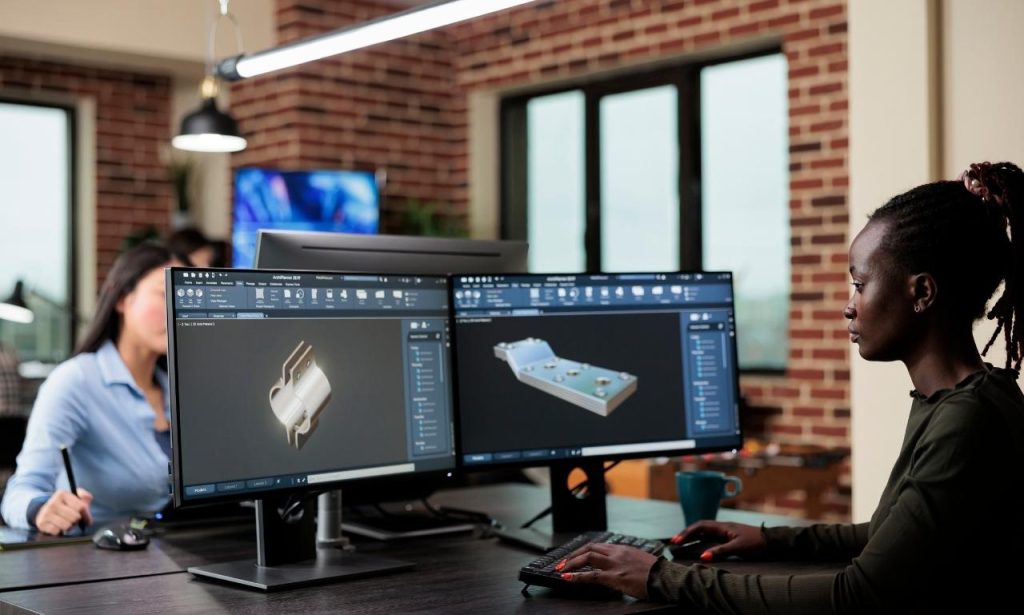
Room scanning applications often generate detailed 3D models after completing a scan. This process involves several stages.
The system first collects thousands of spatial data points. Together, these points form what is known as a point cloud.
Each point represents a location in three-dimensional space. As more points are gathered, the shape of the room begins to emerge.
The software then connects these points into surfaces and geometric structures. This process creates a digital mesh that resembles the physical room.
Finally, textures and object classifications may be added to create a more complete digital representation.
The finished model can be used for interior design, property marketing, renovation planning, and architectural documentation.
How Accurate Are AR Room Measurements?
Accuracy remains one of the most common questions surrounding AR measurement technology.
Under ideal conditions, modern AR systems can achieve surprisingly precise results. Small measurement differences may occur, but many consumer applications now provide accuracy levels suitable for everyday use.
Several factors influence measurement quality.
Lighting conditions play a major role. Dark environments can reduce the effectiveness of camera-based tracking.
Highly reflective surfaces such as mirrors and glass may also confuse depth estimation systems.
Large empty walls sometimes create challenges because they offer few visual reference points.
LiDAR-equipped devices generally perform better in these situations because they rely less on visible textures.
For furniture placement, home improvement planning, and general room measurement, AR accuracy is often more than sufficient. Professional construction projects, however, may still require specialized surveying equipment.
Real-World Uses of AR Room Dimension Technology
The ability to understand room dimensions has created practical applications across numerous industries.
Interior designers use AR to test furniture layouts before making purchasing decisions. Homeowners can experiment with renovations without moving a single piece of furniture.
Real estate professionals create virtual property tours and digital floor plans. Prospective buyers can explore spaces remotely while gaining a realistic sense of scale.
Architects and contractors use room-scanning tools to document existing conditions before beginning projects.
Retailers benefit as well. Customers can visualize products inside their homes before placing orders, reducing uncertainty and improving purchase confidence.
What once required expensive equipment can now be accomplished using a smartphone.
The Future of AR Room Understanding
Room measurement technology continues to evolve rapidly.
Artificial intelligence is making spatial recognition smarter and more reliable. Future systems will not only measure rooms but also understand how those spaces are used.
AR glasses and spatial computing devices are expected to push this capability even further. Instead of scanning a room with a phone, users may interact with continuously updated digital maps of their surroundings.
Digital twins, persistent spatial models, and real-time environmental awareness are becoming increasingly realistic goals.
As hardware improves and software becomes more sophisticated, AR’s understanding of physical space will continue to move closer to human-level perception.
Conclusion
Understanding how AR understands room dimensions requires looking beyond the screen. What appears to be a simple measurement tool actually combines computer vision, motion tracking, SLAM, LiDAR, machine learning, and spatial mapping technologies.
Together, these systems allow AR to build detailed representations of physical environments, calculate distances, identify surfaces, and generate accurate room measurements. As spatial computing advances, the ability of AR to understand and interact with indoor spaces will become even more powerful, opening the door to new applications across design, construction, retail, and everyday life.
Also Read: Can AR Work Without GPS?
FAQs
Yes. Modern AR applications can provide highly accurate measurements for most residential and commercial uses, especially on devices equipped with LiDAR sensors.
No. AR can estimate room dimensions using cameras and motion sensors. LiDAR improves accuracy but is not required.
SLAM stands for Simultaneous Localization and Mapping. It helps AR devices track their position while creating a map of the surrounding environment.
Yes. Many modern smartphones can scan rooms and generate floor plans using AR software, computer vision, and depth-sensing technologies.