Many people assume augmented reality depends entirely on GPS to function. That belief makes sense when popular apps like Pokémon GO use location data to place digital content in the real world. However, the answer to the question “Can AR work without GPS?” is yes. In fact, many of the most advanced AR experiences operate without GPS at all.
Does Augmented Reality Actually Need GPS?
GPS is only one way for an AR system to understand its position. While it helps determine a device’s location outdoors, it is not the technology responsible for placing virtual objects on a table, recognizing walls, or tracking movement around a room.
Most modern AR applications rely on a combination of cameras, sensors, and software algorithms. These technologies allow devices to understand their surroundings in real time. As a result, an AR application can often function perfectly without knowing its exact geographic location.
This distinction is important because GPS answers the question, “Where am I on Earth?” AR tracking answers a different question: “Where am I relative to the objects around me?”
For many AR experiences, the second question matters far more than the first.
How AR Knows Where to Place Digital Objects
To understand how AR works without GPS, it helps to look at what happens when an application launches.
The camera continuously scans the environment. Software analyzes visible features such as edges, corners, textures, and surfaces. At the same time, motion sensors track how the device moves through space.
The system combines this information to create a digital understanding of the environment. Once that happens, virtual objects can remain fixed in place even as the user walks around them.
This process occurs within fractions of a second. Users rarely notice the enormous amount of tracking and analysis happening behind the scenes.
The Role of SLAM Technology
One of the most important technologies behind GPS-free AR is Simultaneous Localization and Mapping, commonly known as SLAM.
SLAM allows a device to build a map of its surroundings while simultaneously determining its position within that map. Instead of relying on satellite signals, it uses visual information captured by the camera.
Imagine entering an empty room and placing a virtual chair in one corner. SLAM enables the AR system to remember where that chair is located, even if you walk away and return moments later.
Without SLAM, modern markerless AR would be far less reliable.
Can AR Work Without GPS Indoors?

Indoor environments provide one of the strongest examples of why GPS is not always necessary.
GPS signals struggle to penetrate buildings effectively. Concrete walls, metal structures, and multiple floors often reduce signal accuracy. In some cases, GPS may become almost unusable indoors.
Yet AR applications work remarkably well inside homes, offices, shopping centers, factories, and hospitals.
The reason is simple. Indoor AR relies primarily on visual tracking rather than satellite positioning.
An interior design app can place a virtual sofa in your living room. A maintenance technician can view digital instructions over industrial equipment. Medical professionals can visualize patient data in operating rooms. None of these experiences require GPS.
The environment itself provides the reference points AR systems need.
Marker-Based AR and GPS-Free Experiences
Not all AR applications use sophisticated mapping systems.
Marker-based AR depends on predefined visual triggers such as QR codes, logos, product packaging, or printed images. When the camera recognizes a specific marker, digital content appears on the screen.
This approach has been used for years in education, marketing, manufacturing, and training programs.
For example, a textbook might contain an image that launches a three-dimensional model of the solar system. A product package might trigger an interactive demonstration when scanned with a smartphone.
Since the marker provides a fixed reference point, GPS becomes completely unnecessary.
Why Marker-Based AR Remains Relevant
Although markerless AR receives most of the attention today, marker-based systems continue to offer several advantages.
They are generally easier to develop, require less processing power, and perform reliably in controlled environments. Businesses often prefer them for training programs and product demonstrations because they deliver consistent results.
In situations where accuracy matters more than mobility, marker-based AR remains a practical solution.
Markerless AR and Environmental Tracking
Markerless AR has transformed the way people interact with digital content.
Instead of relying on printed markers, these systems analyze the surrounding environment directly. Surfaces, walls, floors, furniture, and objects become reference points.
This creates a more natural experience because users can place virtual content almost anywhere.
Applications such as IKEA Place, Snapchat lenses, and many AR gaming experiences use markerless tracking extensively. They detect surfaces and maintain object stability without requiring GPS.
The technology depends heavily on computer vision, motion tracking, and sensor fusion rather than geographic coordinates.
As a result, markerless AR has become the foundation of most consumer AR experiences.
Technologies That Replace GPS in AR
Several technologies allow augmented reality to operate effectively without satellite positioning.
Computer Vision
Computer vision enables devices to interpret visual information captured by cameras. The software identifies patterns, objects, edges, and environmental features.
This capability helps AR systems understand the physical world and maintain accurate positioning.
Inertial Measurement Units
Modern smartphones contain accelerometers and gyroscopes. Together, these components form an inertial measurement unit, often called an IMU.
These sensors track movement, rotation, and orientation. They provide continuous updates even when camera visibility becomes limited.
Depth Sensors and LiDAR
Some devices include depth-sensing hardware or LiDAR scanners.
These technologies measure the distance between the device and surrounding objects. The resulting depth information improves accuracy and environmental understanding.
LiDAR-equipped devices often deliver smoother AR experiences because they can build spatial maps more quickly.
When GPS Is Essential for AR
Although AR can work without GPS, there are situations where location data becomes necessary.
Location-based AR applications depend on geographic coordinates to place digital content in specific real-world locations.
Navigation systems provide a good example. If an application displays directional arrows on city streets, it must know the user’s location. GPS supplies that information.
Popular examples include:
- Outdoor navigation apps
- Tourism experiences
- City exploration platforms
- Location-based advertising
- Geocaching applications
- AR gaming experiences tied to real-world locations
In these cases, GPS acts as a positioning tool rather than the technology responsible for rendering AR content.
The AR experience itself still relies on cameras and sensors for visual accuracy.
GPS vs SLAM: Which Is Better for AR?
Comparing GPS and SLAM reveals why modern AR systems often combine both technologies.
GPS excels at determining broad geographic location. It can tell a device where it is within a city, neighborhood, or outdoor environment.
However, GPS accuracy usually ranges from several feet to several meters. That level of precision is not sufficient for placing virtual objects on a specific chair or table.
SLAM provides far greater local accuracy. It understands nearby surroundings in remarkable detail. The tradeoff is that SLAM does not inherently know global geographic coordinates.
For this reason, many advanced AR platforms use hybrid tracking systems.
GPS provides large-scale positioning. SLAM handles precise local tracking. Together, they create a more reliable experience.
Real-World Industries Using AR Without GPS
Many industries already rely on GPS-free AR solutions every day.
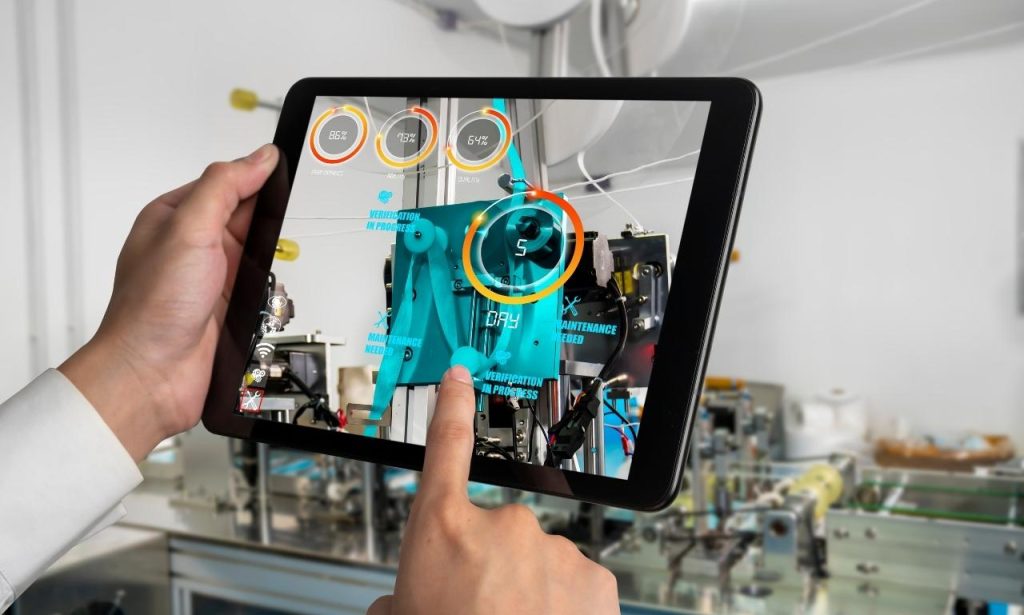
Manufacturing facilities use AR to guide workers through assembly processes. Digital instructions appear directly over equipment and components.
Healthcare organizations use AR for surgical planning, medical education, and patient visualization. These applications operate entirely indoors.
Retail brands allow customers to preview furniture, appliances, and home décor items within their living spaces before making purchases.
Architects and construction professionals use AR to compare digital building models with physical job sites.
Educational institutions create interactive learning experiences that bring complex subjects to life.
In each case, environmental tracking delivers greater value than geographic positioning.
The Future of GPS-Free Augmented Reality
The future of AR is moving toward greater spatial awareness rather than greater dependence on GPS.
Advances in artificial intelligence, visual positioning systems, and spatial computing are making devices more capable of understanding their surroundings.
Future AR glasses may continuously map environments with extraordinary accuracy. Instead of depending on satellite signals, they will rely on cameras, sensors, and cloud-based spatial data.
Visual Positioning Systems, often called VPS, represent one of the most promising developments. These systems identify locations using visual landmarks rather than GPS coordinates.
As hardware improves and software becomes more sophisticated, GPS will remain useful for certain applications. However, many AR experiences will continue to function independently of satellite navigation.
Conclusion
So, can AR work without GPS? Absolutely. Many of today’s most effective augmented reality experiences operate without any GPS input at all.
Technologies such as SLAM, computer vision, depth sensing, and motion tracking allow AR systems to understand and interact with their surroundings. While GPS remains valuable for location-based experiences and outdoor navigation, it is far from a requirement for most AR applications. As augmented reality continues to evolve, environmental understanding will likely play a larger role than geographic positioning, making GPS-free AR more capable than ever.
Also Read:
FAQs
Yes. Many AR applications use cameras, sensors, and SLAM technology instead of GPS to track their surroundings.
GPS signals are often weak indoors. AR applications rely on visual tracking and environmental mapping instead.
SLAM, computer vision, inertial sensors, LiDAR, and depth-sensing technologies commonly replace GPS in AR experiences.
Yes. Pokémon GO uses GPS to determine player location, but it also relies on AR tracking technologies to display virtual objects accurately.
Leave a Reply